Hadrian’s Wall, milecastle by milecastle.
Why an emperor built a wall across Britain, how the forts, milecastles, turrets and the Vallum worked, who lived there (soldiers from across the empire, women and children too), and how to walk the 84-mile National Trail. Every fact is checked against English Heritage, the National Trails, museums and UNESCO, and where they disagree we show both.
The short version
Hadrian’s Wall was built on the orders of the emperor Hadrian after his visit to Britain in AD 122. English Heritage: History of Hadrian’s Wall Hadrian’s biographer recorded that he ordered his army to “build a wall, 80 miles long, to separate the Romans from the barbarians”. English Heritage: Hadrian’s Wall FAQs
It runs from Wallsend in Newcastle upon Tyne in the east to Bowness-on-Solway in Cumbria in the west. English Heritage: Hadrian’s Wall FAQs The first plan was a wall fronted by a wide, deep ditch, with a guarded gate (milecastle) every mile and two turrets in between. English Heritage: Description of Hadrian’s Wall
Mainly built by legionaries, the Wall was manned by auxiliaries, in regiments nominally 500 or 1,000 strong. English Heritage: History of Hadrian’s Wall Soldiers and civilians came to the Wall from as far away as modern Syria, Romania and North Africa. English Heritage: Hadrian’s Wall, History and Stories
For nearly 300 years the Wall was the north-west frontier of an empire that stretched to present-day Iraq and the Sahara. English Heritage: Hadrian’s Wall FAQs
Start exploring
Soldiers from across the empire
The first cohort of Tungrians, recruited around Tongres in modern Belgium, garrisoned Housesteads from the late 2nd to the 4th century. English Heritage: History of Housesteads Roman Fort From the 3rd century Birdoswald was held by the first cohort of Dacians, recruited from what is now Romania. English Heritage: History of Birdoswald Roman Fort Arbeia at South Shields was held by the Fifth Cohort of Gauls and by a unit of Boatmen from the Tigris. North East Museums: Arbeia, the barracks (learning page)
And the writing tablets?
Most Vindolanda writing tablets date to around AD 100; they are thin slices of wood about postcard size, written in ink. British Museum: The Vindolanda tablets More on the Vindolanda tablets.
Enjoying the Wall? Help keep the lights on.
This site is hand-built, fact-checked and free to read. If a fact, a game or one of Useless’s notes made you smile, a little support keeps it going and helps the network grow.
Hadrian’s Wall printables
Fact-checked PDFs in A4 and US Letter, for walkers, history fans, families and classrooms.
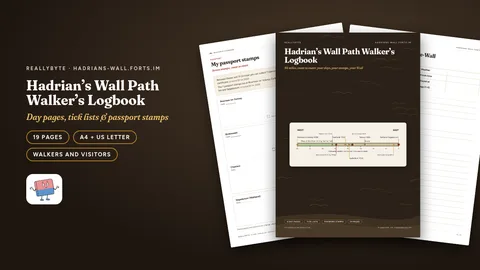
Hadrian’s Wall Path Walker’s Logbook
Walkers and visitors
Plan and log the 84-mile National Trail or a day visit: the six example sections, daily walk pages, passport stamp spots, tick lists of the milecastles, turrets and forts you can still see, Every Footstep Counts, and notes pages
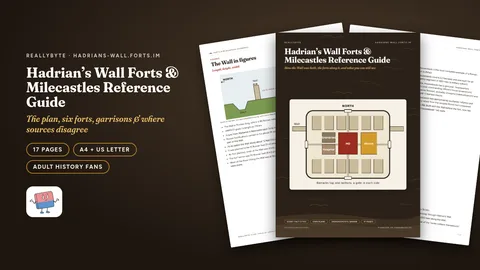
Hadrian’s Wall Forts & Milecastles Reference Guide
Adult history fans
How the frontier worked, from the first plan to the Vallum; the forts of Housesteads, Chesters, Birdoswald, Vindolanda and Segedunum; garrisons, numbering, dimensions, dates, and every place where the sources disagree
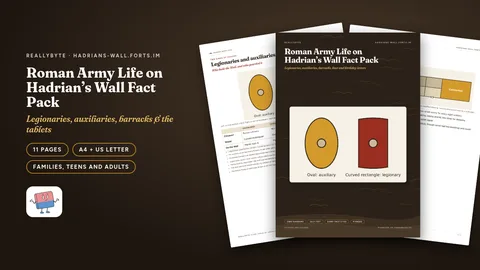
Roman Army Life on Hadrian’s Wall Fact Pack
Families, teens and adults
Legionaries and auxiliaries, units from across the empire, barracks and rations, training, women and children on the frontier, and the Vindolanda tablets, with our own diagrams
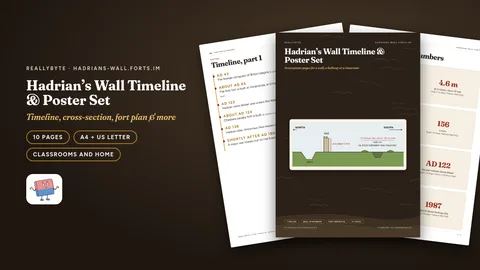
Hadrian’s Wall Timeline & Poster Set
Classrooms and home
Seven poster pages: a two-part timeline from AD 43 to today, the Wall in cross-section, a strip map by milecastle number, inside a Roman fort, legionary or auxiliary, and the Wall in numbers
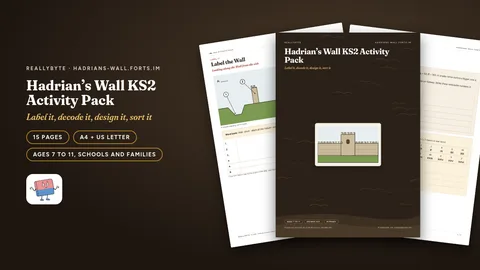
Hadrian’s Wall KS2 Activity Pack
Ages 7 to 11, schools and families
Label the Wall and a fort, a crossword where every answer is a real fact, a Roman numerals codebreaker, a word search, design-a-shield, legionary or auxiliary sorting cards, colouring, a birthday-tablet writing page, a certificate and an answer key
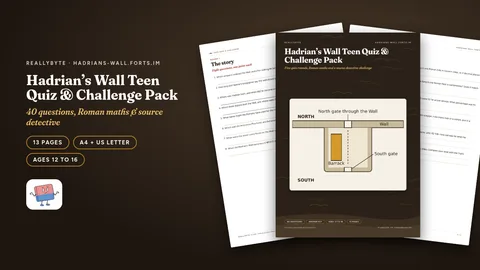
Hadrian’s Wall Teen Quiz & Challenge Pack
Ages 12 to 16
Five quiz rounds, a source-detective challenge on where historians disagree, Roman-mile maths, a primary-source reading of the Vindolanda tablets, and full answers with sources
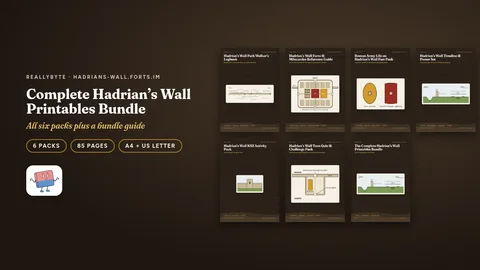 Best value
The Complete Hadrian’s Wall Printables Bundle
All six packs plus a bundle guide, A4 and US Letter, in one download. $12.99 instead of $26.94 bought separately.